
RESOURCES
Authorized Load Testing
A content hub that separates Slammed.st from anonymous booters: legal framing, tool choices, checklists, and real engineering use cases — verified targets only.
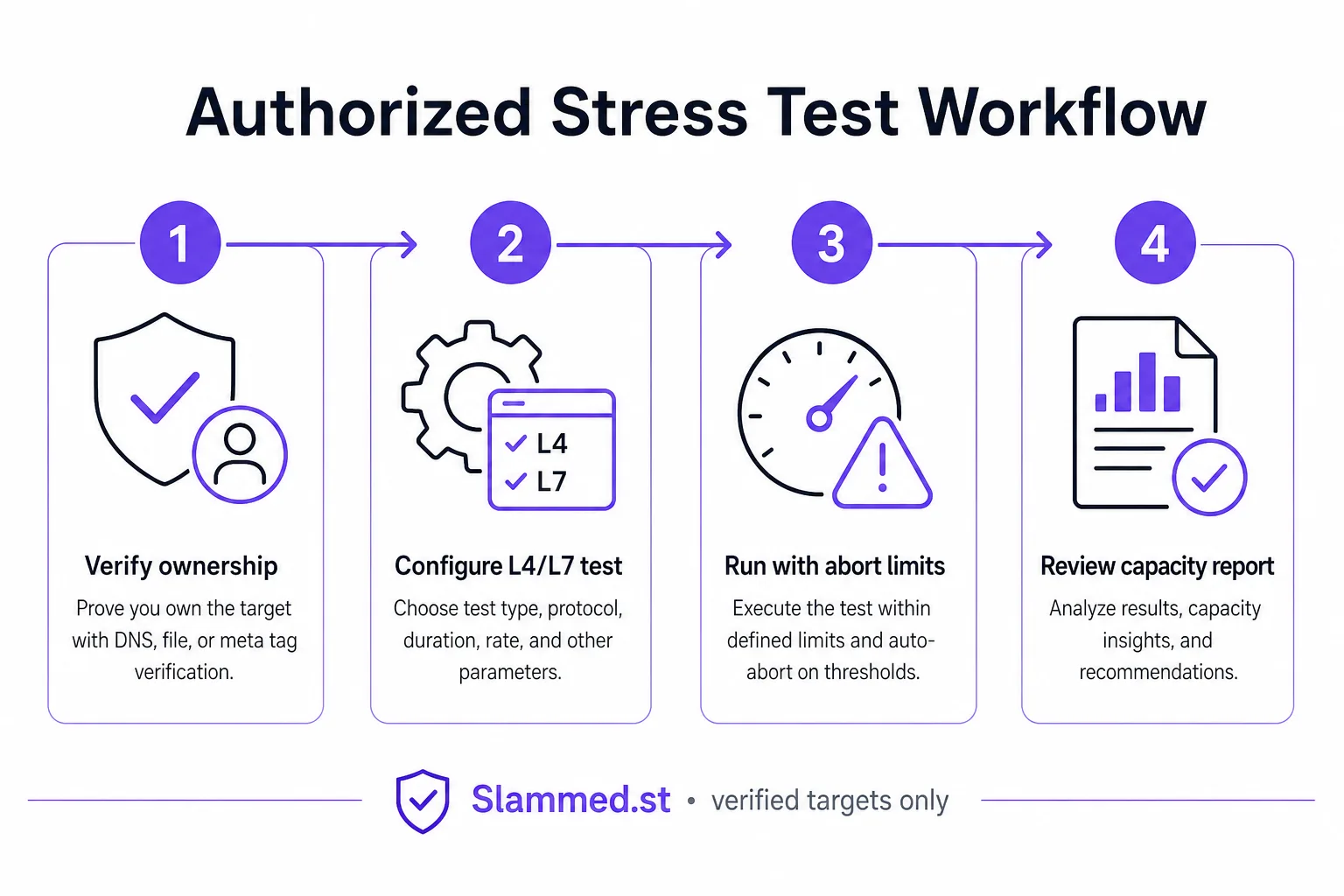
What an IP stresser is (when used legally)
An authorized IP stresser generates controlled Layer 4 / Layer 7 traffic against infrastructure you own or are explicitly allowed to test. The goal is capacity discovery — cliffs, latency, errors — not disruption of third parties.
Deep definition: IP stresser definition & uses · Legal boundary: Is using an IP stresser legal?
Platform signals at a glance: 40 testing regions, up to 4.3 Tb/s peak capacity, 1.2B+ requests tested daily, free Trial with verified targets.
Booter vs authorized stresser
| Authorized stresser (Slammed.st) | Typical booter / “stresser-for-hire” | |
|---|---|---|
| Target policy | Ownership / written authorization required | Often “any IP” |
| Identity | Accounts, invoices, support | Anonymity marketed as a feature |
| Outcome | Capacity reports you can act on | Disruption of someone else’s service |
| Docs | AUP, Terms, Company | Usually none |
Full comparison: Booter vs authorized IP stresser · vs typical stressers.
When to use a panel vs k6 / JMeter / Gatling
Use scripts (k6, JMeter, Gatling) for highly custom protocols, local CI unit-style checks, and protocol fidelity you fully code yourself.
Use an authorized panel when you need multi-region L4/L7 pressure, shared team runs, plan-based capacity, and stop controls without owning a generator farm.
Detail: IP stresser vs k6 / JMeter / Loader.io / Gatling · Slammed.st vs load-testing tools.
Legal test checklist
- Confirm ownership or written permission (scope, intensity, window).
- Notify NOC / providers when intensity warrants it.
- Define abort criteria (p95, errors, CPU/NIC) before ramping.
- Verify the target in-product; keep an instant stop control ready.
- Keep logs and reports for the engineering retrospective.
Full checklist article: Authorized load testing checklist 2026 · Rules: Acceptable Use.
Use cases
Start on Slammed.st
See features, compare pricing, read how it works, or start a free trial on verified targets only.
Commercial guide: Best IP stresser 2026 · Developers: IP stresser for developers · Docs.
Program pitfalls that undermine “authorized” claims
Calling a flood “authorized” does not make it so. Missing written scope, unverified hosts, absent abort criteria, and no on-call owner are how rehearsals become incidents — and how buyers confuse legitimate panels with booters. Keep evidence of permission beside Hub reports, and treat Acceptable Use as an operating constraint, not footer text.
Operational vocabulary lives in the glossary. Commercial sizing stays on pricing. Narrative checklists expand on the blog.
From hub reading to a controlled Hub run
- Confirm ownership or written permission for target, intensity, and window.
- Define abort criteria (p95, errors, host limits) before ramping.
- Verify the target in-product; smoke at low concurrency.
- Ramp L4 or L7 methods that match the hypothesis; stop on abort.
- Capture the capacity report and assign remediation owners.
Start with a free trial. Automations and API surfaces: docs. Use-case entry points: use cases.
When not to run — even on a capable platform
Do not run during unrelated production incidents, without verification, or against infrastructure outside your authorization. Do not use this hub as a guide to disrupt third parties. If your need is only PR-level HTTP contract checks, keep scripts in CI and reserve Slammed.st for shared capacity rehearsals.
Compare tool shapes on vs load-testing tools and trust signals on vs typical stressers.
FAQ
- What is authorized load testing?
- Controlled L4/L7 traffic against infrastructure you own or are explicitly allowed to test, used to find capacity limits — not to disrupt third parties.
- How is an authorized stresser different from a booter?
- Authorized platforms require verification, identifiable accounts, and acceptable use. Booters typically market anonymous attacks against arbitrary targets.
Related
Resources hub · Glossary · Tools matrix · RPS calculator · Useful network tools · Blog · Pricing · Start free