

Why “free IP stresser” results look tempting
Search results for free stressers are dominated by malware droppers, credential-stealing “panels,” and illegal booter funnels. They promise unlimited power with no signup because the product is not a product — it is a lure or a crime service.
Engineering teams that need capacity data should not meet that market halfway. Legal context: Is Using an IP Stresser Legal?
“Free IP stresser” search results exist because the phrase still attracts curiosity, and because malware operators, credential thieves, and illegal booter funnels optimize for that curiosity. The pitch is usually unlimited power, no signup, and instant results — which is economically irrational for a real capacity product that must buy transit, maintain nodes, and support accounts. What you are being offered is often a lure, a stolen-panel clone, or a crime service dressed as a utility. Engineering teams that need reproducible data should not meet that market halfway, even “just to try,” because the first click already accepts a trust model no security review would approve.
Authorized alternatives publish plans, verification, and legal pages because those costs are part of delivering accountable load testing on systems you own. Read the legal boundary in is using an IP stresser legal, the category split in booter vs authorized IP stresser, and the workflow hub at authorized load testing. If a site cannot show Acceptable Use comparable to legal, treat the absence as the answer. Free funnels that skip identity are not a bargain; they are a different product category with different risks, and they have no place in a professional capacity program. Search engines will keep ranking those pages; your buying process should simply refuse to click them.
Concrete risks
- Malware / stolen sessions — “free clients” that loot browsers and wallets
- Legal exposure — free booters aimed at third-party targets
- No accountability — no invoices, no support, no audit trail for your security team
- Junk capacity — exaggerated claims, shared abusive pools, unreliable stops
- Data risk — targets and account details harvested
Booter vs authorized differences: full comparison.
Concrete risks compound quickly. Free “clients” and cracked panels frequently steal browser sessions, wallets, and credentials. Booter-oriented free tiers encourage third-party targeting, which is illegal and can create personal and organizational liability even for a short click. There is no invoice, no support during a runaway run, and no audit trail your security team can attach to a change ticket. Capacity claims are often fiction, stops are unreliable, and shared abusive pools can burn reputation or trigger upstream blocks against your own networks if you experiment carelessly on infrastructure that still matters to customers.
Data risk is under-discussed: targets, notes, and account details entered into anonymous panels become harvestable. That is the opposite of a professional rehearsal, where evidence must survive legal and SRE review weeks later. Prefer the full comparison at booter vs authorized, buyer hygiene in how to choose an IP stresser in 2026, and red-flag context in best IP stresser 2026. Stay on verified, accountable platforms with published Acceptable Use and never confuse “free” with “safe to point at production you care about.” If your finance or security team cannot name the vendor, do not run the test. If you would not paste production hostnames into an untrusted form, do not paste them into a free stresser either — treat that instinct as policy. Incident response becomes harder when the only “vendor contact” is an ephemeral chat handle that disappears after payment.
What to use instead
Use an authorized platform with plans, verification, and legal pages — or script-centric tools like k6/JMeter/Gatling for CI load against your own staging. Buying guide: How to Choose an IP Stresser in 2026. Tool comparison: stresser vs k6/JMeter/Loader/Gatling.
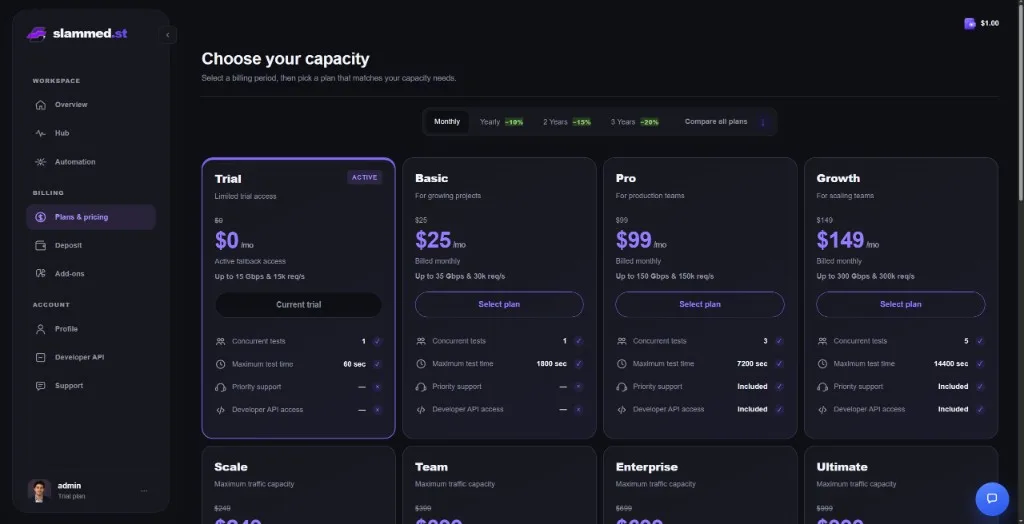
Slammed.st offers a free-to-start Trial plan with authorized testing rules — not an anonymous free booter. Create an account and read Acceptable Use.
What to use instead is straightforward: an authorized load-testing platform with plans, target verification, stop controls, and legal pages — or script-centric tools such as k6, JMeter, or Gatling for CI and staging against environments you control. Script tools excel at performance-as-code; managed panels excel at operator-friendly L4/L7 windows with governance. Many mature teams use both without ever touching a free booter funnel, and that combination still stays inside systems you own or are contracted to test. The comparison at IP stresser vs k6 / JMeter / Loader / Gatling and the buying guide at how to choose an IP stresser in 2026 help you pick the mix without compromising accountability.
Slammed.st offers a free-to-start Trial plan under authorized testing rules — not an anonymous free booter. Create an account, read Acceptable Use, review authorized load testing, and use docs for operator steps. That path gives you invoices, verification, stop reliability, and repeatable evidence your organization can defend in a release review. Anything promising unlimited anonymous power for zero cost is advertising a different, unacceptable risk profile for professional teams preparing launches, seasonal peaks, or protection rehearsals on infrastructure they operate. Budget for accountable capacity the same way you budget for observability: both are how you prove readiness on systems you operate, not how you chase anonymous volume. Prefer a Trial that forces verification over a free panel that rewards anonymity — that single preference filters most of the market.