


Start with your use case, not ads
Write the hypothesis first: “Can our edge absorb X?”, “Does checkout hold at N concurrents?”, “Does autoscaling recover cleanly?” Method, duration, and vendor choice follow from that — not from a homepage Gbps badge.
If the goal is application realism, prioritize L7. If the goal is pipe/firewall validation, prioritize L4. Details: L4 vs L7 when to use.
Start with a written use case, not a Gbps advertisement. Decide whether you are validating an edge pipe, an API launch SLO, a CDN/origin split, a game port you operate, or a seasonal website journey. That sentence dictates method (L4 vs L7), duration, concurrency model, and which stakeholders must watch. Teams that skip this step buy the loudest plan and still cannot say what passed or failed after the run.
Map the use case to layer guidance in L4 vs L7 when to use, concurrency math in concurrent connections vs RPS, and legal boundaries in is using an IP stresser legal. Keep the entire evaluation inside authorized load testing for systems you own, and only then open pricing to see which plan can express that hypothesis.
2026 scorecard: what to check
- Legal & AUP — public terms, acceptable use, abuse process (example).
- Target verification — required before launch, not optional.
- Identity & billing — accounts, invoices, recoverable support — not cash-only anonymity.
- Methods — L4/L7 coverage matching your stack.
- Plan math — concurrents, max runtime, concurrency fairness under multi-tenant load.
- Controls — stop button, history, API if you automate.
- Proof of longevity — uptime narrative, company presence, consistent branding.
Compare shortlists with Best IP Stresser 2026 and bandwidth & trust.
A useful 2026 scorecard weights governance as heavily as capacity. Score public AUP and terms, mandatory target verification, recoverable identity and billing, L4/L7 coverage that matches your stack, clear concurrents and max runtime, stop reliability, run history, and whether support exists during a live window. Longevity signals — consistent branding, docs, and an abuse process — matter because a vanished panel mid-rehearsal is an operational incident of its own. Weight each item so a flashy bandwidth claim cannot outweigh missing verification.
Compare shortlists against best IP stresser 2026, bandwidth trust notes in trusted vs biggest bandwidth, and the category line in booter vs authorized IP stresser. Inspect legal, docs, and plan cards on pricing before you schedule a bake-off on your own targets with monitoring attached.
Red flags
- “Boot any IP” marketing
- No company/legal pages
- Pressure to pay only via untraceable channels with zero KYC for high risk use
- Impossible Gbps claims with no method context
- “Free unlimited” stressers (see why to avoid free stressers)
Those patterns align with booter markets, not engineering platforms — booter vs authorized stresser.
Red flags cluster around anonymity and third-party targeting: “boot any IP” marketing, missing company or legal pages, pressure toward untraceable payment with zero accountability, impossible Gbps claims without method context, and “free unlimited” stressers. Those patterns align with booter markets, not engineering platforms. They raise legal exposure and produce junk evidence your security team cannot audit or attach to a change ticket after the window.
Treat free funnels as a hard stop — why to avoid free IP stressers — and prefer vendors that publish Acceptable Use at legal and authorized framing at authorized load testing. If a pitch cannot survive an internal legal review, it cannot survive a production-adjacent rehearsal either. Keep the comparison grounded with booter vs authorized and walk away early when governance is theater.
Validate with a trial on your own targets
The only honest bake-off is an authorized run against infrastructure you control, with your monitoring attached. Score vendors on time-to-first-result, stop reliability, and whether findings map to real components.
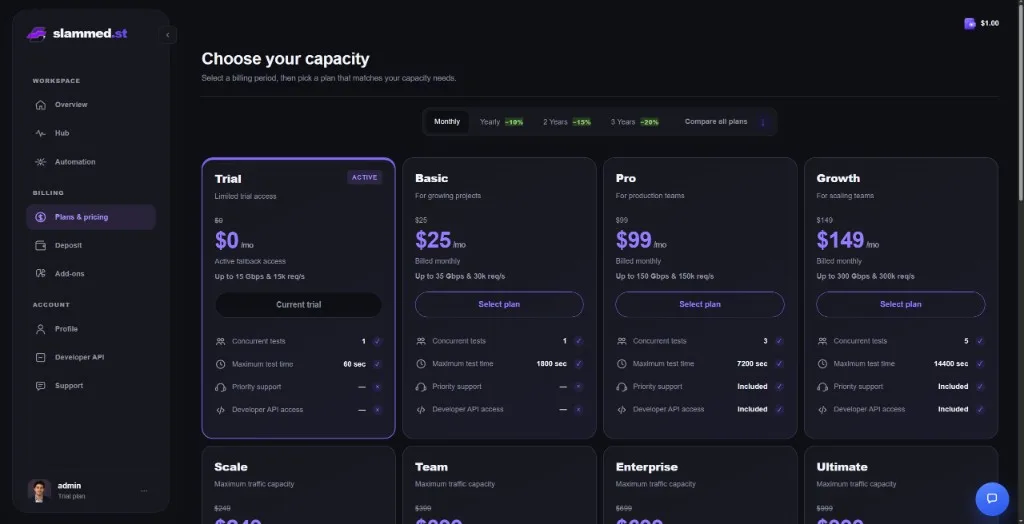
Create a Slammed.st account and size from pricing once the scorecard passes.
Validate with a trial on infrastructure you control, with your monitoring attached. Score time-to-first verified test, clarity of methods, stop reliability, whether findings map to real components, and how easily you can re-run after a fix. A screenshot of “traffic sent” without SLO breach criteria is not a bake-off. Write abort thresholds before you press start and keep cool-down observation in the schedule so recovery defects are not missed.
Create a Slammed.st account, size from pricing, and walk the operator path in docs. Pair the trial with authorized stress test checklist and authorized load testing checklist 2026 so legal and SRE share one definition of done. Upgrade only when the hypothesis needs paid capacity, not because a tier looks impressive on a marketing page.
Document the bake-off in a one-page scorecard shared with security and finance: verification friction, stop reliability, method fit, support responsiveness, and whether findings mapped to real components. A vendor that wins the lab but cannot produce an invoice or AUP still fails procurement. When the scorecard clears, lock the workflow into your runbook and schedule the first production-adjacent window with abort rules already written.