


What you are actually buying
Authorized stresser pricing is capacity rental: how many parallel streams, how long each run may last, and often whether you sit on shared trial capacity or a paid network. Marketing Gbps numbers without those limits are usually noise — see trusted vs biggest bandwidth.
Authorized stresser pricing is capacity rental with governance attached. You are buying how many parallel streams you may open, how long each run may last, which methods you can select, and whether you sit on shared trial capacity or a paid network with stronger isolation. You are also buying the operational surface: verification, stop controls, history, support paths, and published legal terms that your security team can cite. Marketing Gbps badges without those limits are usually noise; trustworthy vendors explain the units you actually consume during a controlled window on systems you own, and they expect you to map those units to a written hypothesis before checkout.
Compare bandwidth claims carefully using trusted vs biggest bandwidth, and map units with concurrents vs RPS. Category risk is covered in booter vs authorized. Before you pay, read Acceptable Use and authorized load testing so procurement and engineering share one definition of the product. Opaque “VIP only” pricing without plan math is a red flag for teams that need auditable spend and repeatable rehearsals rather than anonymous bursts that cannot survive an internal review. Ask vendors to explain what happens at plan limits — hard stop, soft throttle, or queue — because that behavior determines whether your abort rule is still yours to control. Support availability during a live window is part of the price even when it does not appear as a separate line item.
How not to overpay
- Size to the hypothesis (launch API, edge pipe, Black Friday homepage) — not to the top tier by default.
- Prefer clear plan cards over opaque “custom VIP” only pricing.
- Treat add-ons (extra time, API access, advanced methods) as optional until the core plan is proven.
- Ignore free booter funnels — why free stressers are risky.
Scorecard for vendors: 2026 buying guide.
Avoid overpaying by sizing to the hypothesis. A launch API rehearsal, an edge pipe check, and a Black Friday homepage hold do not automatically need the top tier, and buying the top tier rarely invents a missing hypothesis. Prefer clear plan cards over mystery custom quotes as a first step. Treat add-ons — extra time, API access, advanced methods — as optional until the core plan proves the workflow on targets you control. Ignore free booter funnels entirely; they are not discounts, they are risk transfers — see why free stressers are risky. Paying for unused max duration is still cheaper than buying chaos you cannot defend internally after an alarm storm.
Use the 2026 scorecard in how to choose an IP stresser and provider framing in best IP stresser 2026. Duration guidance in how long should a stress test run prevents buying long holds you will abort unused. When the hypothesis is written, open pricing, start via register, and keep docs handy so operators extract value from the plan instead of leaving capacity idle between poorly planned windows on infrastructure you own. A cheap plan that cannot express your hypothesis is more expensive than a mid-tier plan that produces one clean, attributable cliff and a closed remediation ticket. Re-quote after the first successful remediation re-test; many teams drop a tier once the real cliff is known and fixed.
Slammed.st pricing posture
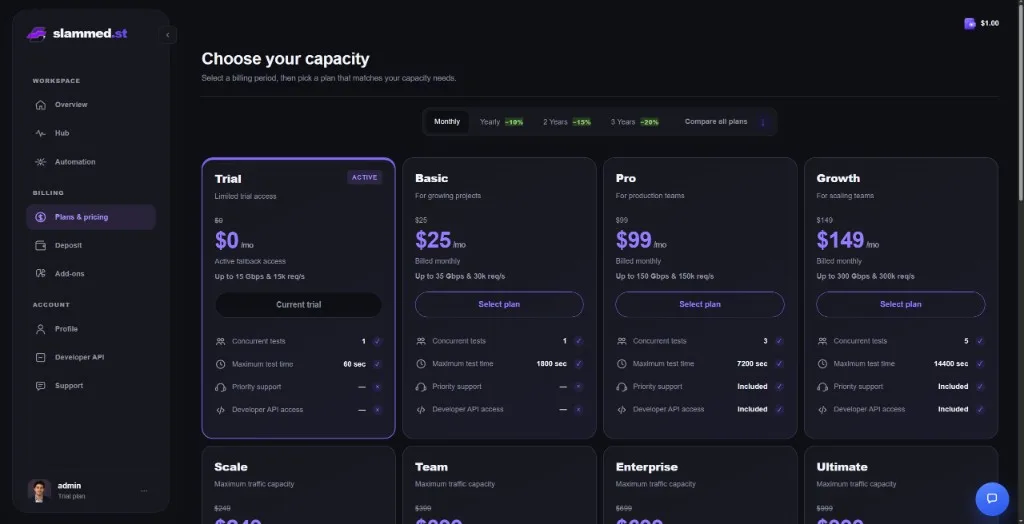
Slammed.st publishes a ladder from Trial upward with concurrents and max time, plus optional add-ons. Wallet/crypto checkout is part of the product surface — compare that honestly to card-first SaaS load tools when you choose. Start on Trial, upgrade when the hypothesis needs paid capacity. Register.
Slammed.st pricing posture is a published ladder from Trial upward with concurrents and max time, plus optional add-ons you can ignore until the core workflow is proven. Wallet and crypto checkout are part of the product surface — compare that honestly to card-first SaaS load tools when your finance process requires a specific rail or invoice trail. Start on Trial to validate verification, stop reliability, and monitoring fit on targets you own; upgrade when the hypothesis needs paid capacity, not when a badge looks larger on a comparison table. The goal is accountable rehearsals with evidence, not anonymous power that your security team cannot approve.
Inspect current cards at pricing, create an account at register, and align stakeholders with authorized load testing and legal. Operator details live in docs. Related reading that keeps spend honest includes concurrents vs RPS and booter vs authorized. Pay for the capacity that answers your written question on infrastructure you operate; leave booter markets and vanity tiers out of the budget conversation entirely, even when a peer team asks for “more Gbps” without a hypothesis. When finance asks what they purchased, answer with concurrents, max time, and authorized scope — not with a marketing bandwidth adjective. Trial is for learning the control plane; paid capacity is for expressing a hypothesis your monitoring can judge pass or fail.