
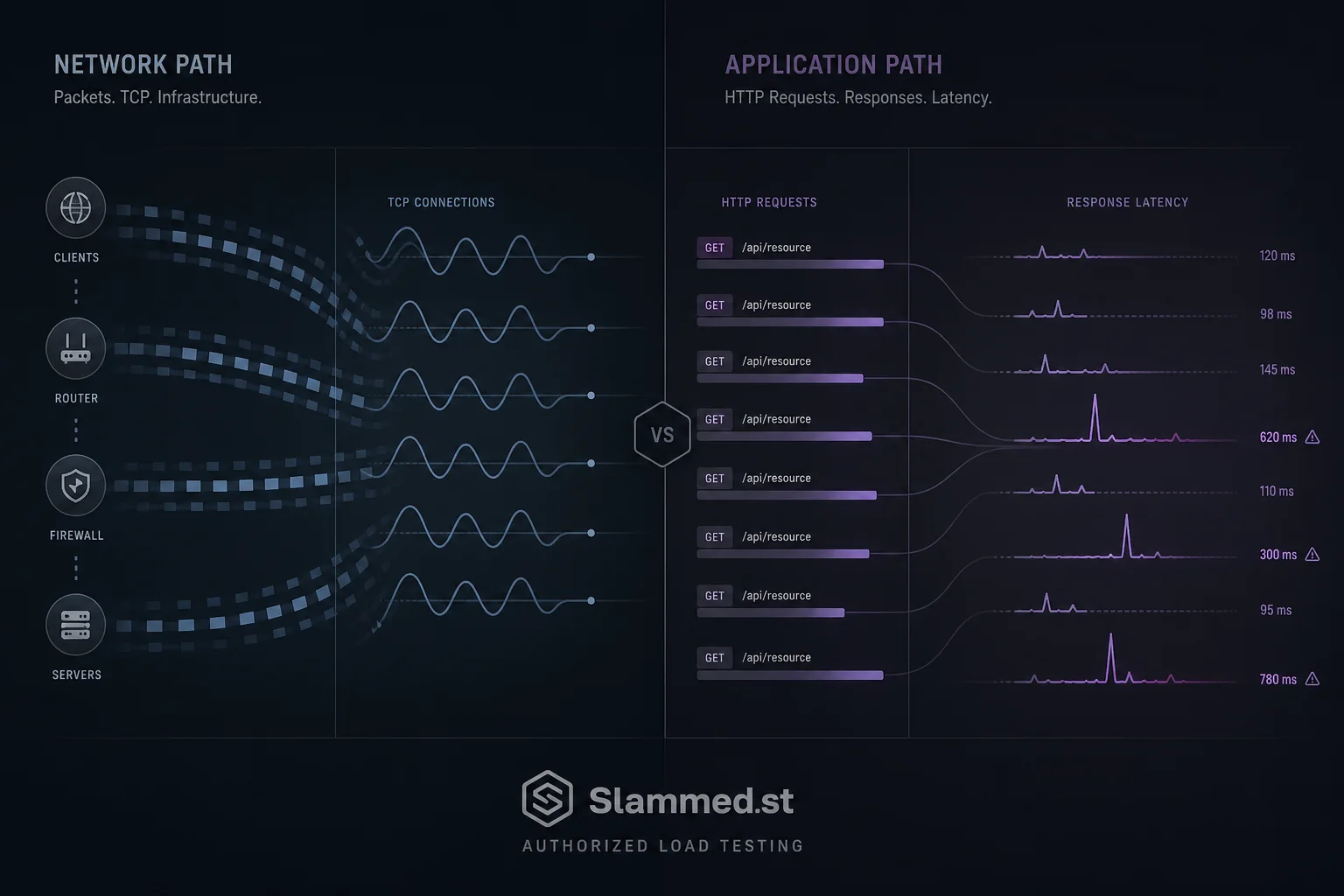
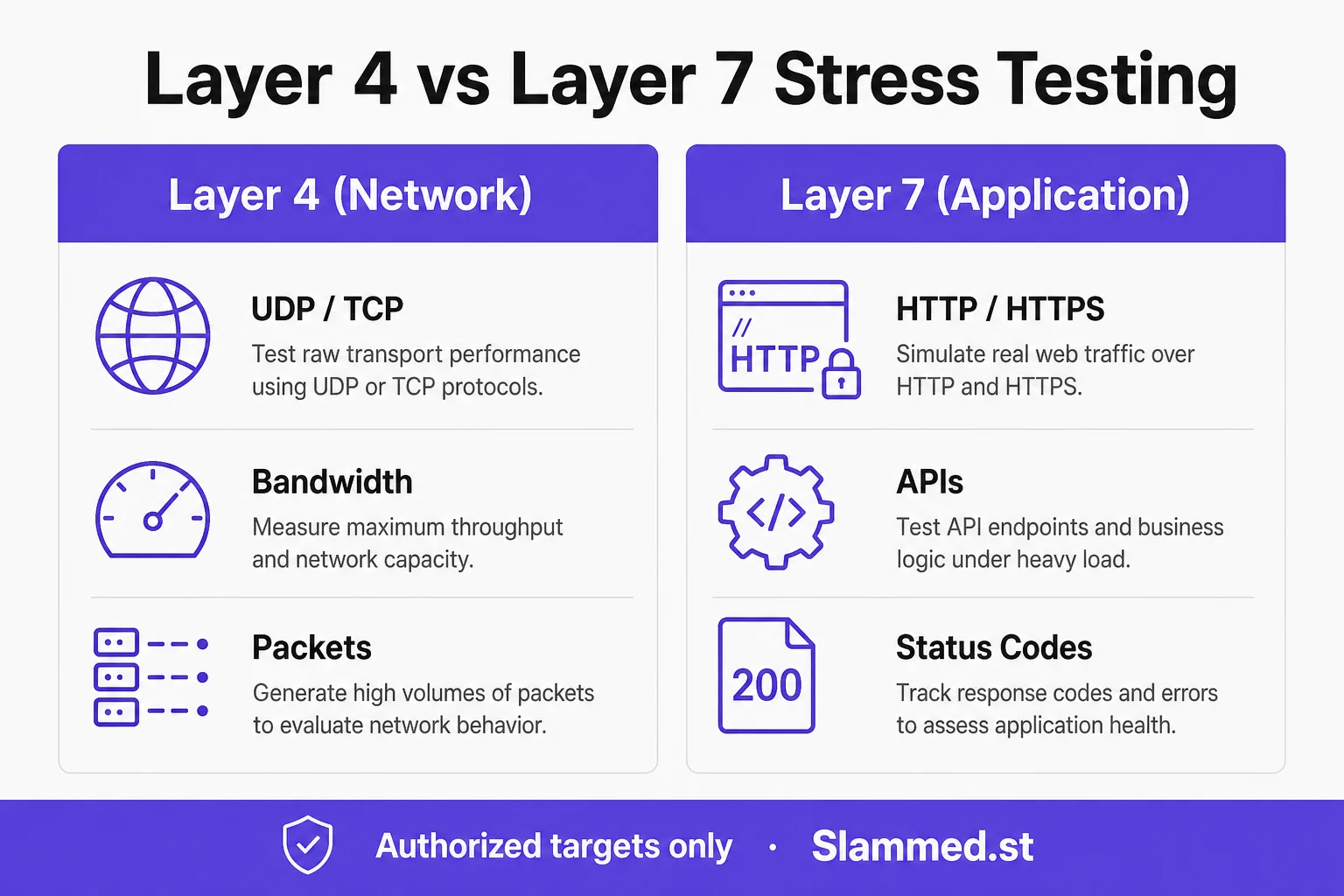

The real difference between L4 and L7
Layer 4 stress testing exercises the transport and network path — TCP/UDP connections, packet rates, bandwidth, firewalls, scrubbing, and connection tables. Failures often look like packet loss, resets, or saturated NICs rather than HTTP status codes.
Layer 7 stress testing exercises the application — HTTP(S) requests, TLS termination, caches, API gateways, app servers, and databases. Failures show up as rising p95/p99 latency, 5xx errors, queue buildup, or WAF challenges on legitimate paths.
They answer different questions. Treating “more L4 Gbps” as a substitute for checkout realism is how teams get false confidence. For website-focused context see What Is a Website Stresser?.
Beyond the OSI labels, the practical difference is which failure mode you expect to see first. Layer 4 pressure tends to surface packet loss, resets, saturated interfaces, firewall connection-table exhaustion, and scrubbing handoff delays. Layer 7 pressure tends to surface TLS cost, gateway queues, application thread or pod saturation, cache miss storms, database pool waits, and WAF challenges on otherwise legitimate paths. Mixing those signals without labeling the method produces false confidence — a quiet HTTP dashboard during an L4 cliff, or a “healthy NIC” while checkout 5xx climbs.
Teams that document the layer in the ticket, the runbook, and the postmortem learn faster and re-test cleaner. If your primary question is website or API realism, begin with L7 guidance in what is a website stresser and API before launch. If the question is pipe or mitigation, pair L4 with DDoS protection testing checklist. Always stay inside authorized load testing on systems you own.
When to use Layer 4
Choose L4 when your hypothesis is about the perimeter or pipe:
- ISP handoff and edge bandwidth ceilings
- SYN/connection-table pressure on firewalls or load balancers
- Scrubbing / DDoS mitigation onboarding and time-to-mitigate
- UDP or TCP service endpoints that are not HTTP-first
Instrument interface counters, conntrack, firewall drops, and provider dashboards — not only APM. Pair with DDoS protection testing checklist.
Use Layer 4 when the hypothesis lives at the perimeter or transport path: ISP handoff ceilings, load-balancer SYN or connection pressure, UDP/TCP services that are not HTTP-first, or onboarding a scrubbing provider where time-to-mitigate is the metric that matters. Instrument interface counters, conntrack, firewall drops, and provider dashboards — not only APM traces. Short stepped probes usually beat a single max-length blast because the first cliff appears quickly and longer traffic after that may only deepen collateral noise.
Keep authorization explicit: owned IPs or written permission, notified NOC, and abort rules before start. Review Acceptable Use, size duration and concurrents on pricing, and prefer verified inventory through register. Related reading that keeps L4 scoped correctly includes common bottlenecks and the operational sequence in authorized stress test checklist.
When to use Layer 7
Choose L7 when user journeys and APIs matter:
- Login, search, cart, checkout, or GraphQL/REST endpoints
- CDN cache effectiveness and origin shielding
- WAF false positives under concurrency
- Autoscaling reaction for application pods/VMs
Before peak retail events, L7 is usually the primary rehearsal — see stress test before Black Friday.
Use Layer 7 when user journeys and APIs define success: login, search, cart, checkout, GraphQL or REST endpoints, CDN cache effectiveness, WAF false positives under concurrency, and application autoscaling reaction. Failures here are measured in p95/p99 latency, error classes, queue depth, and origin request rate — not raw Gbps. Mirror production headers, keep-alive behavior, and think-time so the run answers a release question instead of a synthetic vanity metric.
Before retail peaks, L7 is usually the primary rehearsal; see stress test before Black Friday and the print-friendly website load testing checklist 2026. Behind a CDN, decide whether you are stressing edge cache or origin first — stress testing behind Cloudflare / CDN. Start controlled windows via register and keep governance linked from authorized load testing.
How to combine them without muddying results
Run a short L4 probe if the edge is in doubt, then an L7 scenario that mirrors production traffic shape. Change one primary variable per iteration. Abort when you have the signal — not when marketing “max” is reached.
Operational sequence: authorized stress test checklist. Sister guide: Layer 4 vs Layer 7 stress testing.
Combining L4 and L7 works when you sequence them and change one primary variable per iteration. A short L4 probe can clear doubt about the pipe or firewall; a following L7 scenario can then mirror production traffic shape without blaming the wrong layer. Abort when you have the signal. Holding both at maximum simultaneously usually muddies ownership of the first failure and wastes cool-down attention.
Operationally, write the order into the runbook, attach the right dashboards for each phase, and re-test after each fix. Process detail lives in how to run an authorized stress test and stress testing best practices. For tooling that supports fast method switching on verified targets, compare panels and scripts in IP stresser vs k6 / JMeter / Gatling, then size capacity on pricing once the sequence is agreed.