


Environments and realism
Prefer staging that mirrors production capacity and config, or tightly scheduled production windows with clear abort criteria. Synthetic environments that omit WAF/CDN will not predict edge behavior.
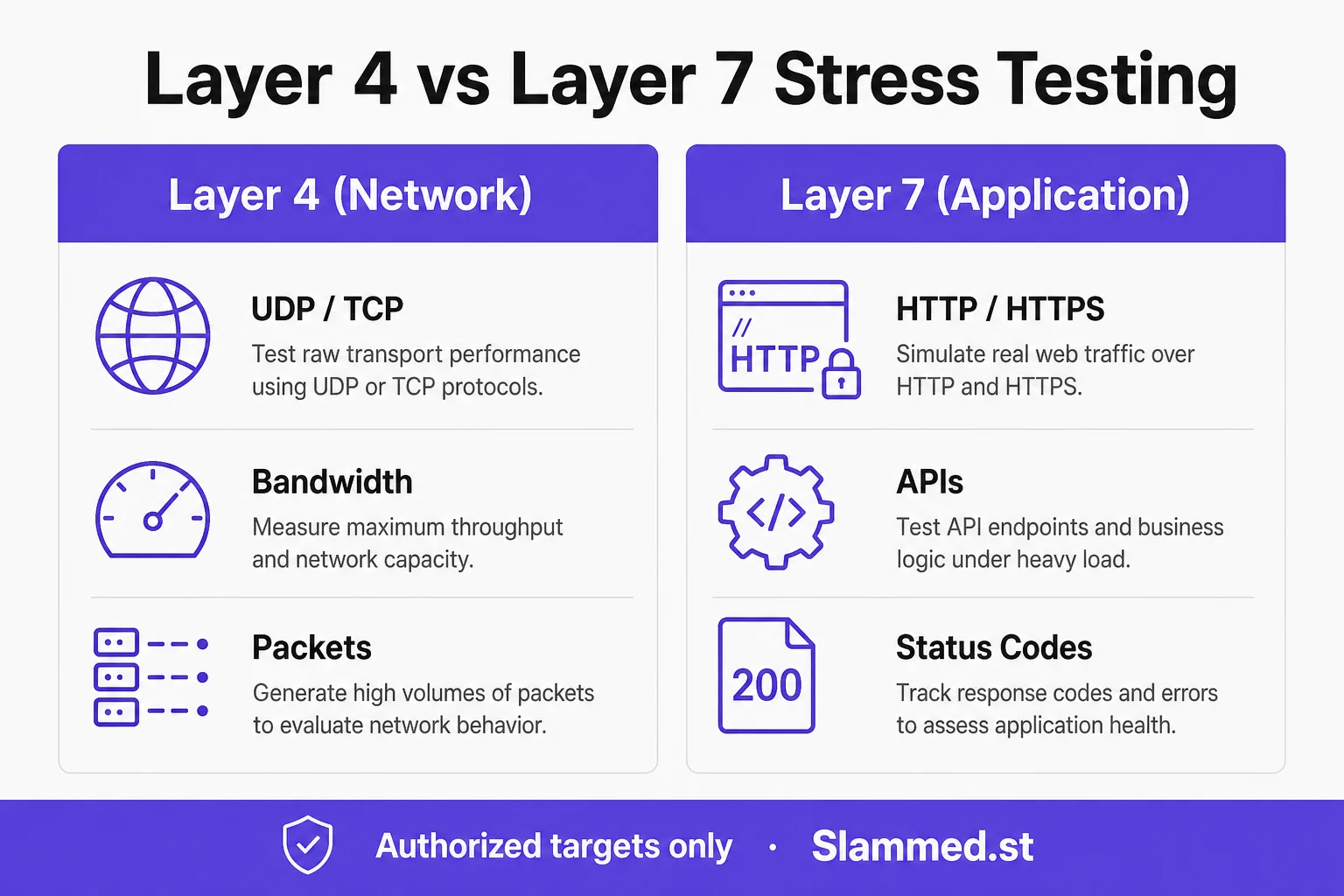
Align method choice with L4 vs L7 and website specifics in website stressers.
This section expands on Environments and realism for teams that need more than a one-line definition. Authorized stress testing is a measurement discipline: you apply controlled load to infrastructure you own, watch where it bends, and feed the findings into capacity and protection work.
Write down the hypothesis before you start. If you cannot explain what failure mode you expect to observe, you are not ready to choose a method or concurrency. Short iterative runs with clear abort criteria beat a single unmanaged peak.
Pair every run with observability on both the edge and the origin. Latency percentiles, error rates, connection-table pressure, WAF challenges, and recovery after stop are the signals that turn traffic into decisions.
Keep the work accountable. Use identifiable accounts, verified targets, and published rules such as Slammed.st Acceptable Use. Browse related material on the blog when you need adjacent topics.
Call out known staging gaps in the ticket: missing WAF, smaller databases, or different CDN configs. Stakeholders should not treat a green staging graph as production proof when parity is incomplete. If you must test production-adjacent paths, shrink blast radius, notify on-call, and keep abort ownership explicit — see authorized load testing.
Ramp, don’t blast
Sudden max concurrency hides the threshold where things break. Step concurrency, pause to observe plateaus, and record the first failing dependency. Keep runs shorter than your attention span for monitoring.
This section expands on Ramp, don’t blast for teams that need more than a one-line definition. Authorized stress testing is a measurement discipline: you apply controlled load to infrastructure you own, watch where it bends, and feed the findings into capacity and protection work.
Write down the hypothesis before you start. If you cannot explain what failure mode you expect to observe, you are not ready to choose a method or concurrency. Short iterative runs with clear abort criteria beat a single unmanaged peak.
Pair every run with observability on both the edge and the origin. Latency percentiles, error rates, connection-table pressure, WAF challenges, and recovery after stop are the signals that turn traffic into decisions.
Keep the work accountable. Use identifiable accounts, verified targets, and published rules such as Slammed.st Acceptable Use. Browse related material on the blog when you need adjacent topics.
Publish the ramp table before start: concurrency steps, hold duration, and the metric that trips abort. Live debates about “one more step” are how controlled tests become incidents. After each step, glance at cool-down candidates — queues that already look sticky are a reason to stop early. Duration guidance: how long should a stress test run.
Assign named watchers: one for the stresser UI, one for edge/CDN, one for origin APM. Shared screenshots without owners produce postmortems full of “we thought someone was looking.” Correlate panel output with your own telemetry; the panel generates load, your metrics decide pass/fail. Tooling split with scripts: stresser vs k6/JMeter.
Common mistakes
- Testing without authorization or stakeholder notice
- Judging success only by “we sent traffic”
- Ignoring recovery after the stop
- Chasing vendor Gbps instead of your hypothesis
- Skipping a re-test after remediation
Trust and vendor selection tips: most bandwidth & trusted. Full operational checklist: authorized stress test.
This section expands on Common mistakes for teams that need more than a one-line definition. Authorized stress testing is a measurement discipline: you apply controlled load to infrastructure you own, watch where it bends, and feed the findings into capacity and protection work.
Write down the hypothesis before you start. If you cannot explain what failure mode you expect to observe, you are not ready to choose a method or concurrency. Short iterative runs with clear abort criteria beat a single unmanaged peak.
Pair every run with observability on both the edge and the origin. Latency percentiles, error rates, connection-table pressure, WAF challenges, and recovery after stop are the signals that turn traffic into decisions.
Keep the work accountable. Use identifiable accounts, verified targets, and published rules such as Slammed.st Acceptable Use. Browse related material on the blog when you need adjacent topics.
Avoid trophy hunting — max plan concurrency on day one teaches less than a hypothesis-sized ramp. Avoid silent windows that surprise the NOC. Avoid skipping re-tests after fixes; a ticket without proof is only a theory. When ready, register, size from pricing, and keep Acceptable Use in the advisory.
Operations notes and common pitfalls
Teams often under-communicate. A stress window that is “known to engineering” but unknown to the NOC still creates chaos. Publish a short advisory: start/stop time, expected symptoms, escalation contact, and the exact targets in scope.
Another frequent mistake is changing too many variables at once — method, concurrency, cache rules, and WAF mode in a single run. Change one primary variable per iteration so causality stays clear when you write the post-test report.
Finally, budget time for recovery validation. Confirm that queues drain, autoscaling cools down, and error rates return to baseline after stop. If recovery is sticky, that finding is as important as the peak breaking point. See the authorized checklist and best practices for fuller process detail.
When you are ready to execute on verified infrastructure, create a Slammed.st account and size the plan to the hypothesis — not to a marketing Gbps number. Pricing context lives on the pricing page.
After the run, require a one-page report template: hypothesis, steps, first failing component, cool-down notes, tickets filed, and re-test date. Ritualizing the write-up is how best practices survive staffing changes. Hub and policy links: authorized load testing, docs.