
RESOURCES
Concurrent connections
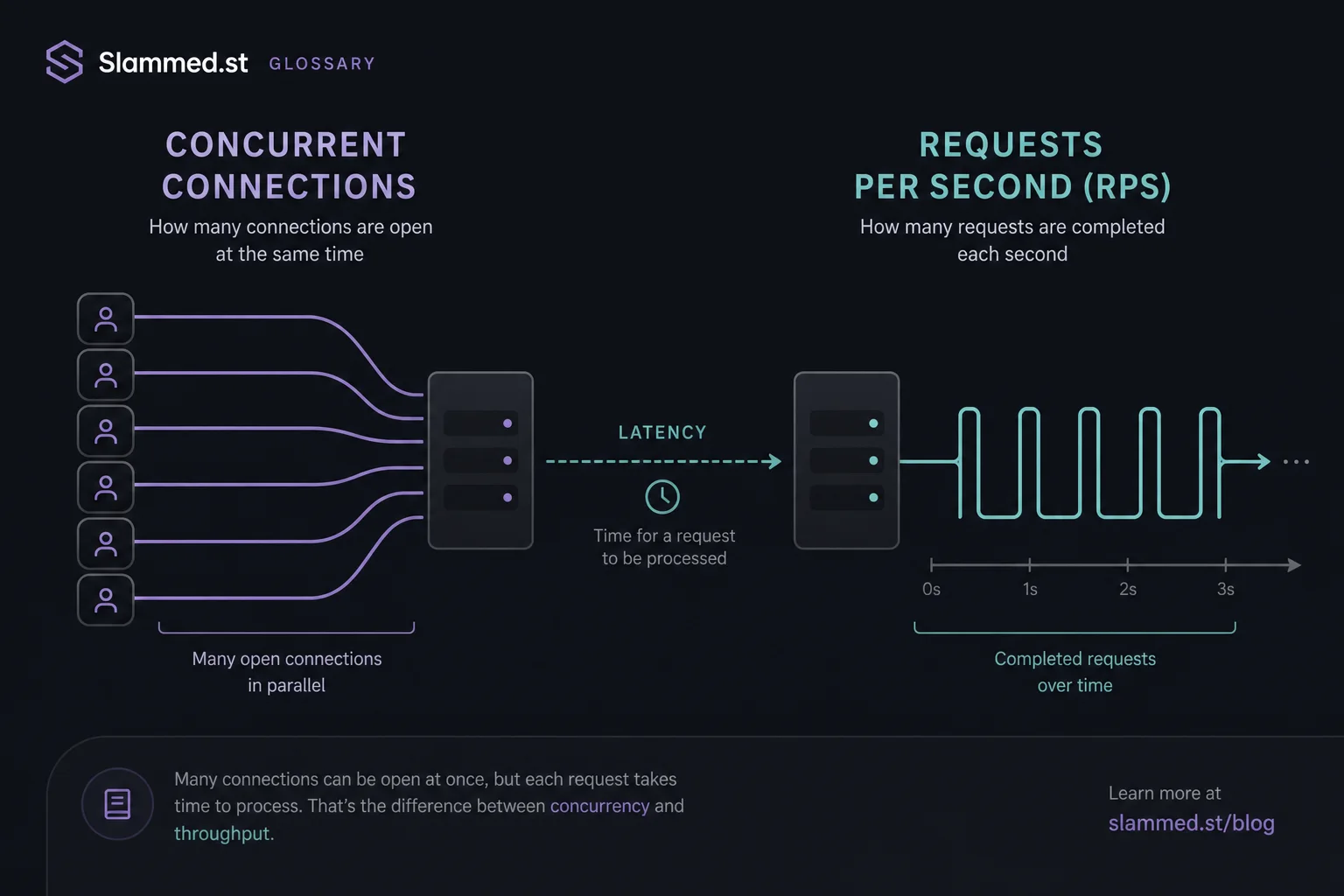
Concurrent connections (concurrents) are the simultaneous sessions or workers a test holds open against the target — pressure on pools and keep-alives, distinct from completed RPS.
Definition
Concurrent connections count how many simultaneous client sessions or virtual workers are active against the system under test. Each concurrent may be waiting on a response, sitting in think time, or holding a keep-alive. The metric pressures connection tables, thread pools, file descriptors, and load-balancer limits.
Concurrents are not interchangeable with RPS. Slow backends can raise open sessions while throughput flatlines. Little’s Law links them when latency is known: concurrents ≈ RPS × latency_seconds.
See also latency and throughput.
Why it matters for authorized load testing
Release questions often sound like “can we survive 2,000 concurrent checkouts?” That is a concurrency hypothesis. Answering it on infrastructure you own requires ramping workers in steps, watching p95/p99 and errors, and stopping when abort criteria fire.
Teams that confuse concurrents with RPS mis-size generators and miss connection-table cliffs that appear before CPU looks busy. Authorized practice reports both metrics plus latency.
Calculator and examples: Concurrent vs RPS tool · deep dive.
How Slammed.st uses it
Slammed.st plans expose a concurrent-worker ceiling for authorized runs. You configure concurrents in the Hub for L4/L7 methods on verified targets, then observe whether the target’s completed work and latency stay inside budgets. Higher plan tiers unlock higher concurrent caps — not a guaranteed RPS promise.
Compare envelopes on pricing or register for a free trial. Hub overview: features.
Glossary cluster
Browse related term pages and the hub glossary:
- RPS
- Concurrent connections (this page)
- Latency
- Soak test
- Abort criteria
- Throughput
- Layer 4
- Layer 7
- Verified target
- Spike test
- Load testing glossary (hub)
Concurrents as pressure, not proof of work
Concurrent connections stress pools, keep-alives, and connection tables even when each session is slow. Quoting only concurrents in a report hides whether the system completed useful requests. Always pair open workers with RPS, latency, and errors.
Plan concurrents on Slammed.st are a purchase ceiling for generators — achieved application concurrency on the target is an outcome. Calculator: concurrent vs RPS. Index: glossary.
How to ramp concurrents responsibly
- Smoke at Concurrent 1; confirm charts and host signals.
- Step upward; pause long enough to read p95/p99.
- Watch for RPS stall while concurrents climb — classic saturation shape.
- Stop on abort criteria; cool down before the next experiment.
Buy headroom on pricing. Learn Hub stop controls via register. Policy: authorized load testing.
When concurrency is the wrong knob
If payloads are tiny and latency is already low, chasing ever-higher concurrents may not teach you anything new — focus on realistic journeys and error budgets. If the hypothesis is raw pipe volume, L4 metrics may matter more than HTTP worker counts.
Deep dive on the blog. Product notes in docs. Related throughput entry: throughput.
Related
Resources hub · Glossary · Tools matrix · RPS calculator · Useful network tools · Blog · Pricing · Start free