
RESOURCES
Use cases for authorized stress testing
Pick the scenario that matches your hypothesis — then run controlled L4/L7 traffic on infrastructure you own. Each path below is a rehearsal pattern, not a license to hit third-party systems.
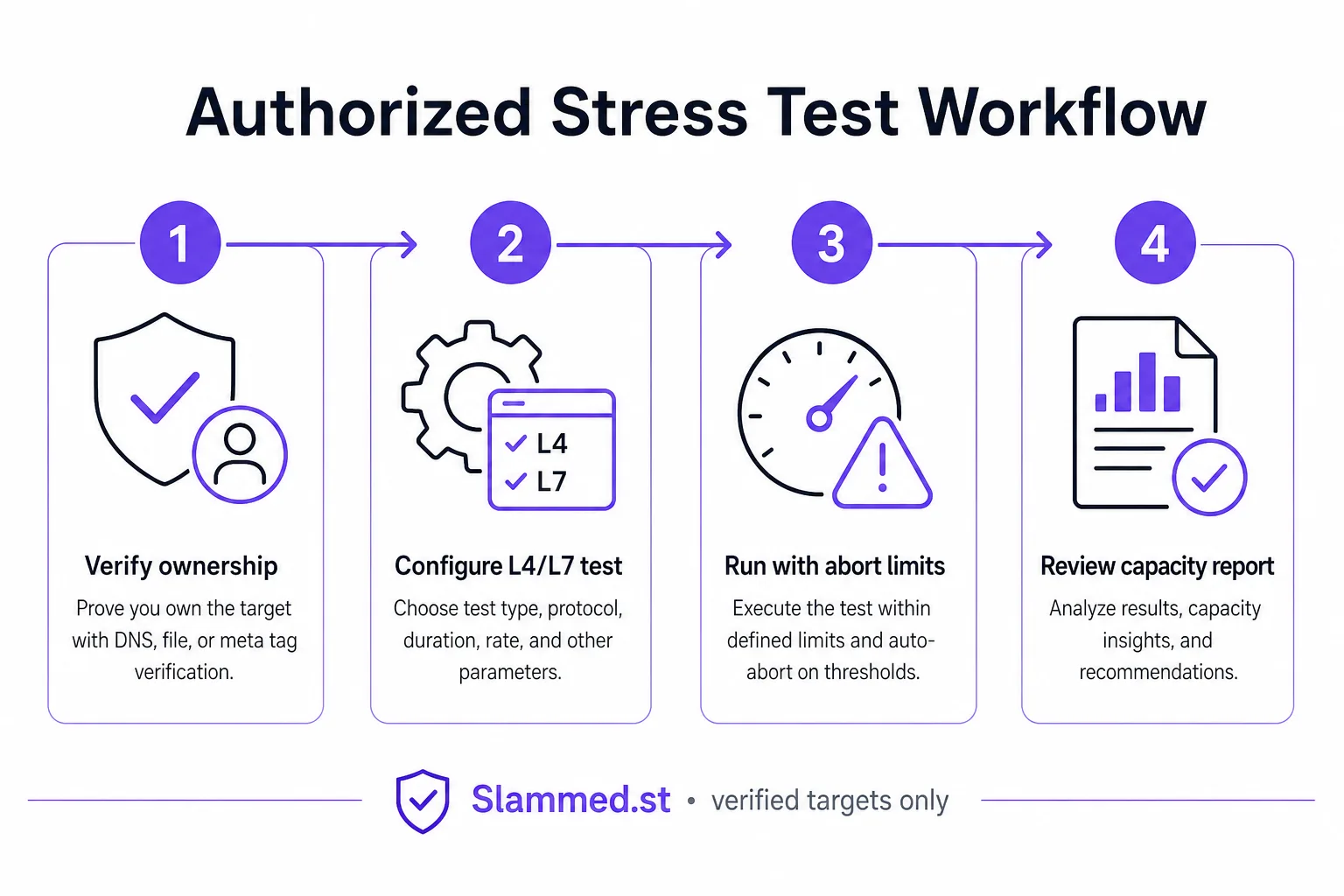
How to choose a use case
Start from the failure mode you fear: checkout JSON dying at peak, UDP game ticks collapsing under joins, or a CDN that looks fine while origin pools melt. Map that fear to a layer (L4 vs L7), a concrete path, an abort rule, and a cool-down. Then open the matching guide.
Platform framing lives on the Authorized Load Testing hub. Method vocabulary: Layer 4 and Layer 7. Capacity sizing: pricing and the concurrent vs RPS calculator.
Choose a path
- API load testing — auth, checkout, search, and write paths before release. Pair with API before launch and 50k–100k RPS prep.
- Website capacity testing — campaign and Black Friday peaks on properties you operate. See Black Friday checklist.
- Game server testing — UDP/TCP and lobby APIs for titles you host. Playbook: game server guide.
- CDN / WAF testing — separate edge absorption from origin pain. Deep dive: behind Cloudflare.
Shared rules for every use case
- Verify the exact target and keep written approval with the report.
- Smoke short (30–60s), then ramp one knob at a time — time, rate, or concurrents.
- Watch Hub metrics and your own APM/CDN counters; abort when budgets break.
- Never aim runs at systems without authorization — see AUP.
Browse more playbooks on the blog, skim the glossary, or start a free trial.
Choosing a use case without boiling the ocean
The use-cases hub exists so teams pick one risk story per window: API release, website campaign, game shard, or CDN/WAF edge. Running all four hypotheses in a single afternoon usually yields noisy charts and weak abort discipline. Start from the failure you fear most this quarter, then schedule sibling runs only after the first report has owners.
Policy spine: authorized load testing. Method primers: Layer 4 and Layer 7. Vocabulary: glossary.
Suggested path from hub to Hub panel
- Open the child page that matches your risk (API, website, game, or CDN/WAF).
- Write abort criteria and verification scope before touching generators.
- Estimate concurrents with concurrent vs RPS and confirm on pricing.
- Register or sign in, verify the target, smoke, then ramp.
Playbooks and checklists expand on the blog; automation surfaces are in docs.
When this hub is not the right entry point
If you are still deciding authorized panel vs scripts vs anonymous stressers, start at vs load-testing tools or vs typical stressers instead of a use-case page. If you only need a definition, use the glossary. Do not use these pages to plan tests against systems you do not control.
Related
Resources hub · Glossary · Tools matrix · RPS calculator · Useful network tools · Blog · Pricing · Start free