
RESOURCES
API load testing
Rehearse auth, checkout, and search APIs under controlled L7 load before customers find the cliff.
Why APIs need a dedicated run
Staging traffic rarely matches production concurrency. An authorized L7 stress test against your own API shows pool exhaustion, rate-limit surprises, and slow handlers while you still control the blast radius.
Separate read-heavy browse paths from write paths (checkout, token mint, uploads). A pretty health endpoint does not prove the conversion API will survive peak.
Recommended flow
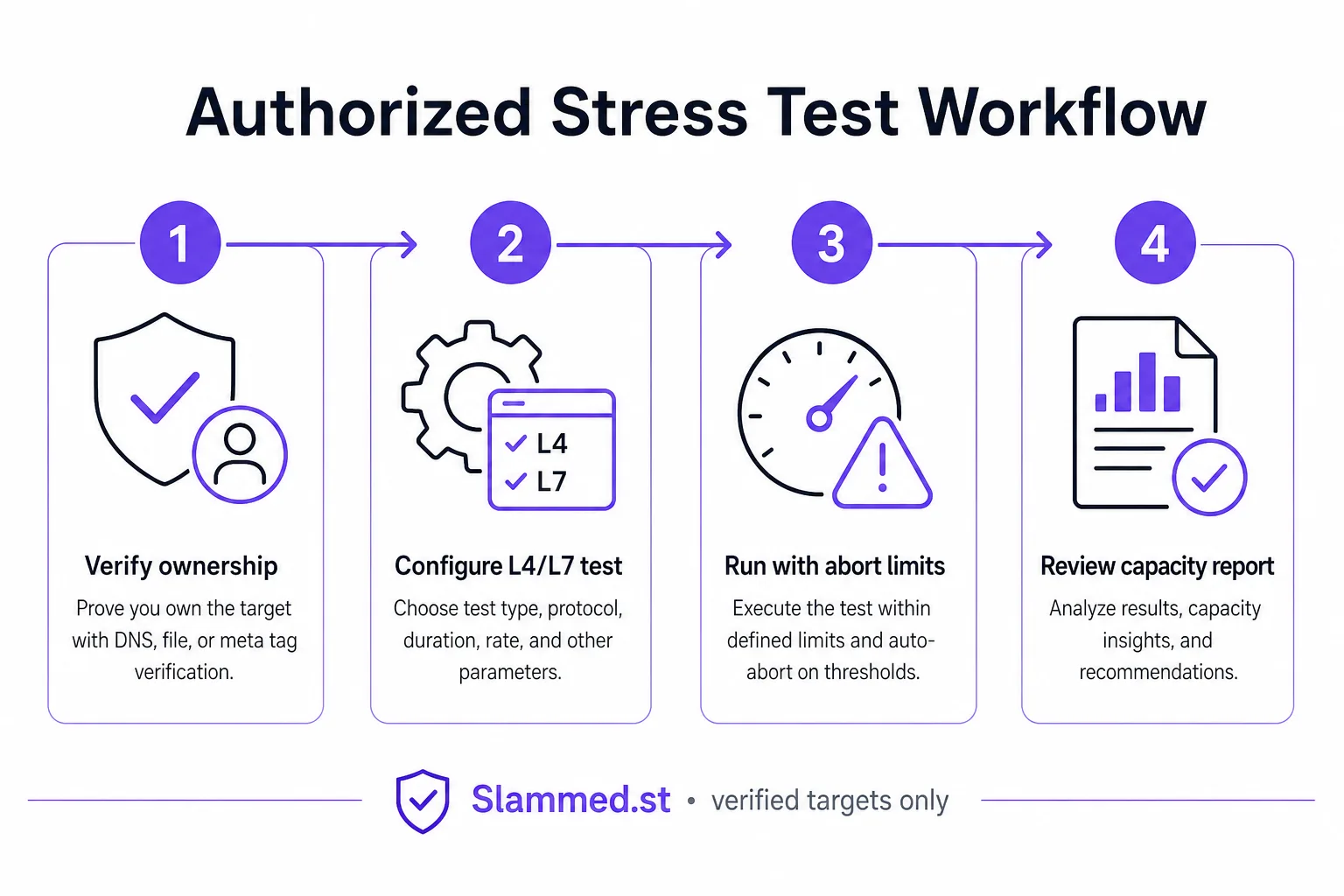
- Verify the target and notify on-call.
- Define abort: p95 latency, error %, CPU/NIC.
- Smoke 30–60s at Concurrent 1, then ramp concurrents; note the stable plateau.
- Export findings into the release checklist and ticket owners.
Full playbook: Stress test an API before launch. High-RPS prep: 50k–100k RPS. Metrics primer: concurrents vs RPS. Size on pricing.
Safety
Only APIs you own or are authorized to test. See AUP, all use cases, and start free.
API-specific pitfalls
API load tests go wrong when the health endpoint becomes the only scenario, when auth tokens expire mid-ramp, or when rate-limit 429s are ignored because “connections still open.” Write paths (token mint, checkout, uploads) often cliff long before read caches. Idempotency keys, pagination cursors, and webhook callbacks can also amplify load in ways a single GET never shows.
Define success codes and retry policy before the run. If clients retry aggressively under timeout, Hub RPS and origin work can diverge. Related terms: RPS, latency, abort criteria.
Sequence for a release rehearsal
- Verify the API host and confirm staging vs production scope in writing.
- Smoke auth + one read path; confirm APM traces appear for the same routes.
- Hold a read plateau; record stable RPS inside the latency budget.
- Run a separate write/conversion scenario with tighter abort thresholds.
- Export cliffs into tickets with owners, then cool down before any higher step.
Size workers with concurrent vs RPS and plan limits on pricing. Broader framing: authorized load testing.
Metrics APIs need beyond average latency
- p95/p99 per route, not a blended service average.
- Error taxonomy: timeouts vs 5xx vs auth failures vs upstream 502s.
- Pool saturation: DB connections, thread pools, gateway queue depth.
- Saturation shape: concurrents rising while RPS stalls.
Hub tip: name each Hub scenario after the route under test so reports map cleanly to SRE tickets. Automation and API control surfaces are covered in docs; narrative playbooks sit on the blog.
When not to stress the API in Hub
Keep contract checks and schema fuzzing in CI with scripts. Skip Hub ramps during active incidents, schema migrations without a rollback, or when authorization only covers a mock that does not share production pools. Never point authorized generators at third-party APIs you do not operate.
Start free on verified targets, then graduate to paid concurrents when the release window needs longer plateaus. Sibling journeys: website capacity and Layer 7 stress testing.
Related
Resources hub · Glossary · Tools matrix · RPS calculator · Useful network tools · Blog · Pricing · Start free