
RESOURCES
Authorized IP stresser vs booter
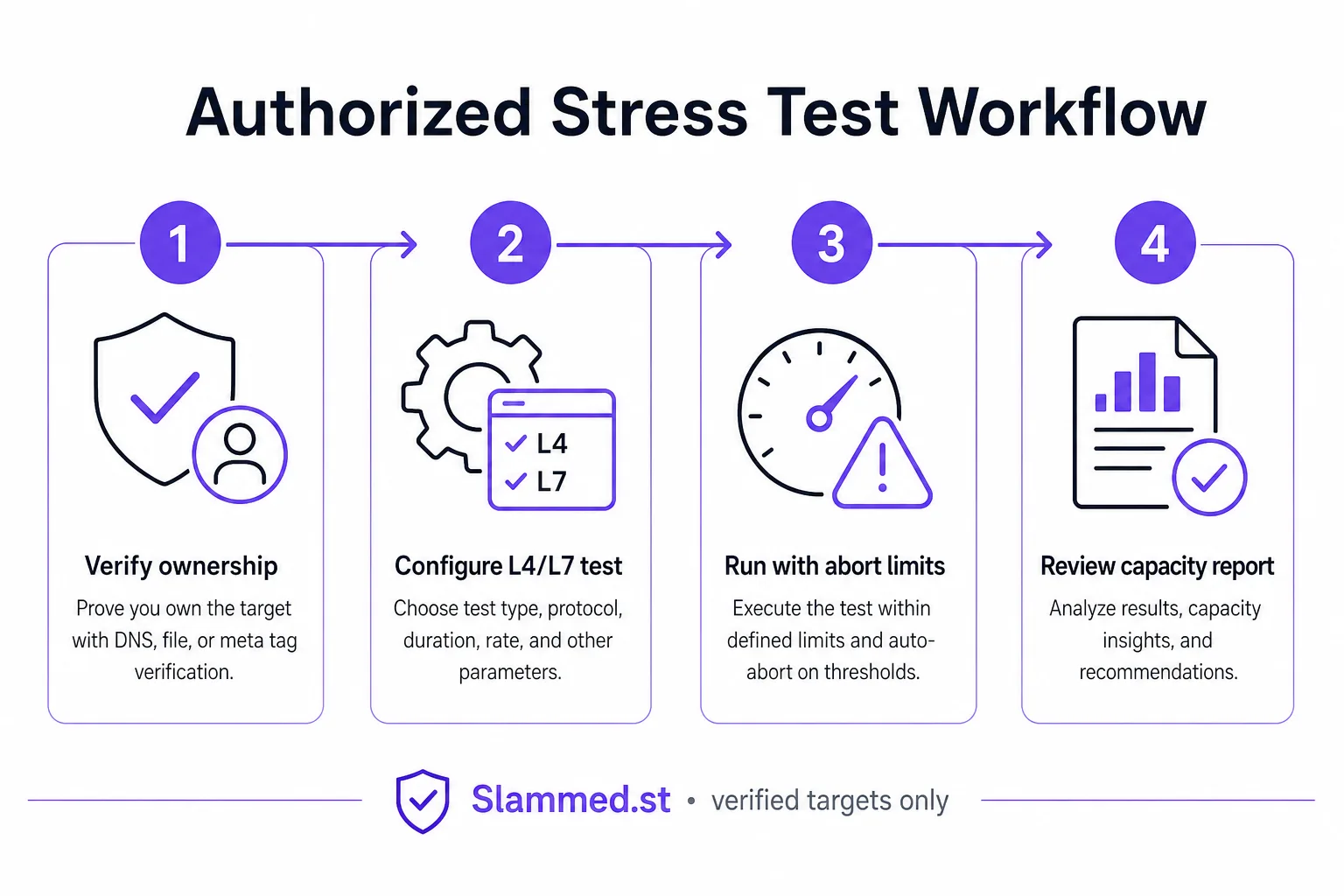
Same search keywords, opposite products. One measures capacity you own. The other sells anonymous attacks. This page is the decision guide for teams that need a legal, accountable rehearsal tool.
Why the keywords collide
People search “IP stresser” for two incompatible jobs: (1) find how much traffic an API, site, or game path can sustain before latency and errors break the budget, and (2) hire anonymous flood traffic against someone else’s IP. Marketing language from abuse panels polluted the SERP, so buyers must separate product shape before they compare price or Gbps claims.
Slammed.st only serves the first job. If you need disruption of third parties, stop here — that use is banned under our Acceptable Use and Terms.
Side-by-side
| Authorized stresser | Booter / stresser-for-hire | |
|---|---|---|
| Target policy | Verified ownership / written permission | Often “any IP” |
| Accounts | Identifiable billing and support | Anonymous crypto panels |
| Goal | Find bottlenecks and stable capacity | Disrupt third parties |
| Observability | Live metrics, abort, reports for SRE | “Online” vanity with no engineering loop |
| Docs | Legal center, AUP, company pages | Usually none |
| Risk to buyer | Process + plan limits on your estate | Legal / abuse / payment fraud exposure |
How to tell which category you are looking at
- Verification: Can you start a run without proving you own the host? If yes, walk away.
- Positioning: Does the site talk about “boots”, revenge, or competitors’ IPs? That is not load testing.
- Support & company: Is there a real company, status page, and published rules? Abuse panels rarely keep durable identity.
- Engineering outputs: Do you get concurrents, max time, RPS/Gbps class, abort, and a report you can file as a ticket — or only a timer?
For the long narrative comparison, read DDoS booter vs authorized IP stresser and the legal framing at Is using an IP stresser legal?.
Where Slammed.st sits
Slammed.st is an authorized L4/L7 load-testing platform: plan-based concurrents and runtime, multi-region generators, Hub stop controls, and rules that prohibit testing systems you do not control. Capacity is sized on pricing; operators follow how it works and the Authorized Load Testing hub.
Related comparisons: vs typical stressers, vs k6 / JMeter / Gatling, alternatives index, and the fat matrix at load testing tools matrix.
Create an account only if you will test verified targets. Check status before large windows.
Practical next step
- Write the hypothesis (layer, path, abort rule) with SRE and legal.
- Verify the exact host or IP on Trial — no card required.
- Run a short smoke, then scale duration/concurrents only if signals stay clean.
- Keep evidence of approval next to the report using the 2026 checklist.
Related
Resources hub · Glossary · Tools matrix · RPS calculator · Useful network tools · Blog · Pricing · Start free