


Why developers still search for an IP stresser in 2026
Developers search for an IP stresser for developers 2026 because application performance problems are no longer separate from release engineering. A deployment is not truly ready if the API falls apart under concurrency, if the CDN origin path collapses under a burst, or if an infrastructure change looks good in staging but fails under production-like pressure. Developers want tools that help them connect performance hypotheses to real decisions.
That is why the modern question is not "How do I blast traffic?" but "How do I test safely, repeatably, and with evidence?" For developers, the useful stresser is the one that supports documented workflows, verified targets, and fast coordination with SRE and security. Anything less creates more risk than value.
If you need the broader tool comparison first, start with IP stresser vs k6, JMeter, Loader.io, and Gatling.
API-first testing is where developers get the most value
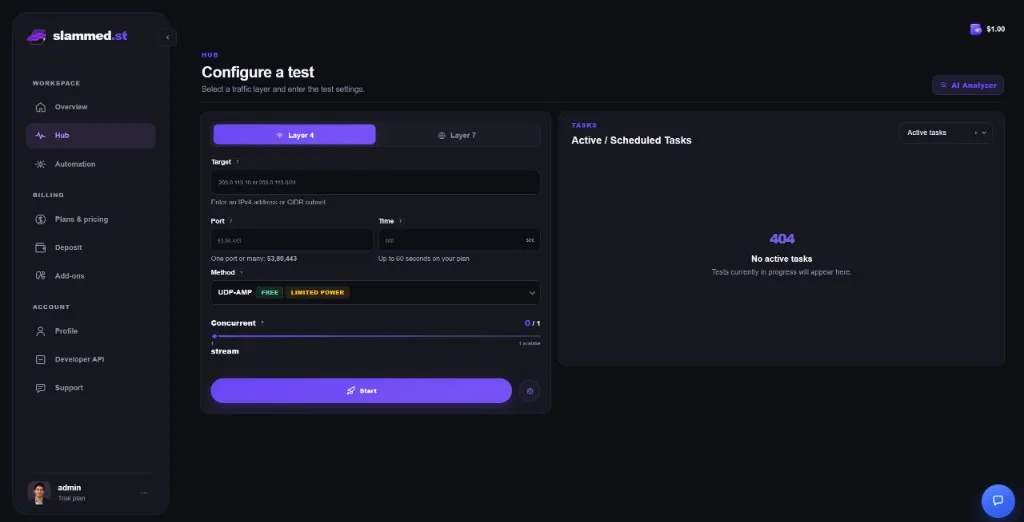
For most development teams, the highest-value tests are API-centric. They reveal slow dependency chains, exhausted connection pools, weak caching, and queue pressure before users describe them as outages. An authorized stresser becomes helpful here when it can target the exact owned environment you care about, align the traffic pattern to the behavior you want to inspect, and make it easy to stop or repeat a run.
Developers do not need mystery traffic. They need enough control to compare one release or configuration against another. That means named scenarios, visible method choices, and output that can be lined up with APM, logs, and infrastructure metrics. The more directly the tool supports that loop, the more useful it becomes for engineering.
Reference material and integration details belong in /docs, while the platform view of capabilities lives at /features.
Where IP stressers fit in CI without overusing them
An IP stresser does not need to sit in every pull request pipeline to be valuable. In fact, forcing large load tests into every CI run often creates noise, cost, and unnecessary risk. A better model is tiered. Use code-level and script-level performance checks continuously, then use a managed authorized stresser for scheduled smoke tests, pre-release validation, or weekly rehearsals on higher-risk paths.
This approach keeps CI fast while still giving developers access to controlled production-adjacent evidence when it matters. You can tag certain branches, releases, or environments as eligible for heavier runs and route them through a shared workflow that SRE can monitor. That is far easier to govern than letting every engineer improvise large traffic tests from scratch.
If your team wants repeatable policies, document those triggers near your release process and mirror the provider's rules from /legal and /terms.
API automation and developer-friendly workflows
What developers really want from a stresser is not just traffic. They want automation hooks that fit normal engineering habits. That includes the ability to standardize scenarios, capture run history, compare results over time, and keep operational controls obvious. Whether that interface is a dashboard, an API, or both, the important thing is that it supports repeatability rather than one-off heroics.
An API or docs portal becomes especially useful when you are coordinating between teams. Platform engineers can define templates, developers can trigger approved checks, and SRE can supervise the windows that touch sensitive environments. That creates a healthier boundary between experimentation and production operations.
For implementation details and platform usage, keep /docs close at hand, then connect those workflows to the purchase and access path at /pricing and /register.
Developers still need an explicit authorized testing boundary
Developers sometimes treat authorization as something "handled elsewhere," but that is a mistake. If you are the person wiring the workflow into a release process, you need to know exactly which targets are approved, which environments can be tested, and how stakeholders are notified. This is not just legal hygiene. It protects production stability and keeps the team from normalizing unsafe shortcuts.
The right provider helps by making the authorized boundary easy to understand. Public rules, verification, and visible onboarding reduce ambiguity. They also make internal approvals much easier when compliance or security asks why a given platform belongs in the stack.
Review /authorized-load-testing and is using an IP stresser legal before adding any heavier test workflow to your engineering process.
The developer next step: use the right tool at the right layer
The best IP stresser for developers in 2026 is the one that works with your engineering process instead of bypassing it. Use scripts for routine checks, use an authorized panel when you need faster cross-team coordination or broader L4/L7 coverage, and keep documentation close so every run has a clear owner and purpose.
Continue with /docs, compare methods at /features, inspect pricing, and start a verified workflow through /register. Related reads include 50k-100k RPS preparation and Black Friday readiness testing.