
RESOURCES
Abort criteria
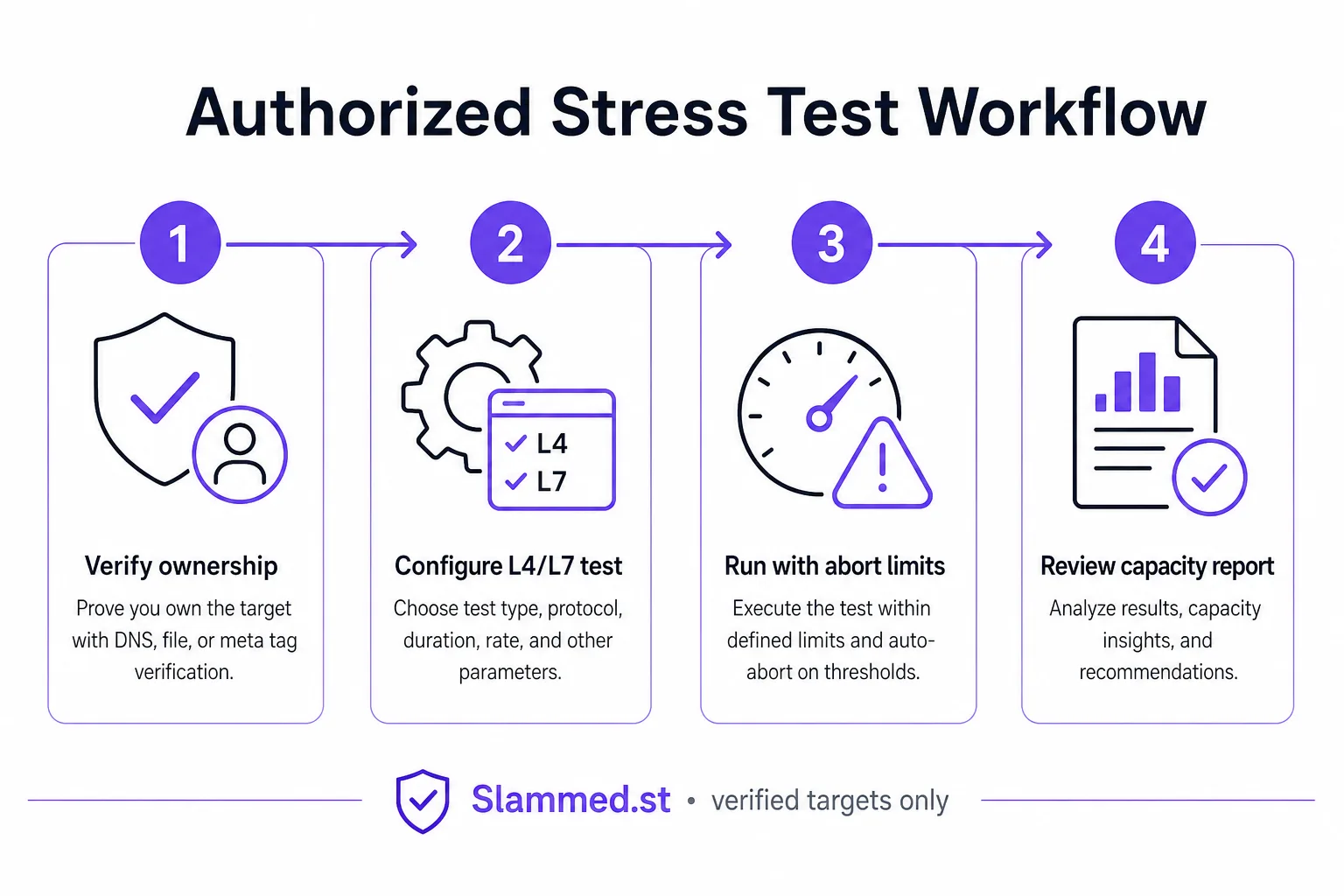
Abort criteria are pre-agreed stop rules — latency ceilings, error rates, CPU/NIC thresholds — so an authorized test ends when the system is harmed or the question is answered.
Definition
Abort criteria are explicit thresholds written into the run plan before load starts. Typical examples: p95 latency above X for Y seconds, error rate above Z%, NIC drops rising, or a business signal (checkout fail spike). When a rule fires, operators stop the generators instead of debating mid-incident.
Abort criteria turn a stress rehearsal into a controlled experiment. They are not optional polish; they are how authorized testing stays inside a defined blast radius on infrastructure you own or may test in writing.
Related: latency, verified target, spike test.
Why it matters for authorized load testing
Without abort rules, “find the cliff” becomes “keep hammering a broken path.” That wastes the change window, pollutes metrics, and can extend customer impact if the target shares production capacity. Legal and AUP framing also expect responsible stop behavior — see Acceptable Use.
Good abort criteria are measurable, owned by on-call, and paired with cool-down so recovery is observed. Document them next to ownership proof for the ticket.
How Slammed.st uses it
Slammed.st provides instant stop controls and live metrics so operators can enforce abort criteria during authorized Hub runs. Plan caps on concurrents and duration add hard ceilings; verification ensures the target is allowed before meaningful load.
Practice the stop path on free trial, then size real windows on pricing. Checklist culture: authorized load testing.
Glossary cluster
Browse related term pages and the hub glossary:
- RPS
- Concurrent connections
- Latency
- Soak test
- Abort criteria (this page)
- Throughput
- Layer 4
- Layer 7
- Verified target
- Spike test
- Load testing glossary (hub)
Abort criteria are a safety control, not a suggestion
Abort criteria are pre-agreed stop rules — p95 latency, error rate, CPU, NIC saturation, business signals — that end a stress test before uncontrolled damage. Improvising thresholds mid-run is how “short tests” become incidents. Write aborts into the change ticket before generators start.
Related: spike test, soak test, verified target. Hub culture: authorized load testing.
How to operationalize aborts in Hub
- Agree numeric thresholds with SRE and NOC (and CDN/WAF owners when relevant).
- Verify the target; confirm who watches the stop control.
- Ramp in steps; abort on the first breached rule — do not “push through.”
- Capture the cliff in the report; cool down; only then plan the next hypothesis.
Practice stop discipline on a free trial. Size windows on pricing. Automation hooks: docs.
When weak aborts are worse than no test
If nobody can define a stop rule, do not run production intensity. If authorization is missing, do not run at all. Vanity spikes without aborts teach the wrong lesson: that overload is acceptable entertainment.
More vocabulary: glossary. Narrative checklists on the blog. Calculator for sizing before you approach the cliff: concurrent vs RPS.
Related
Resources hub · Glossary · Tools matrix · RPS calculator · Useful network tools · Blog · Pricing · Start free