
RESOURCES
Latency
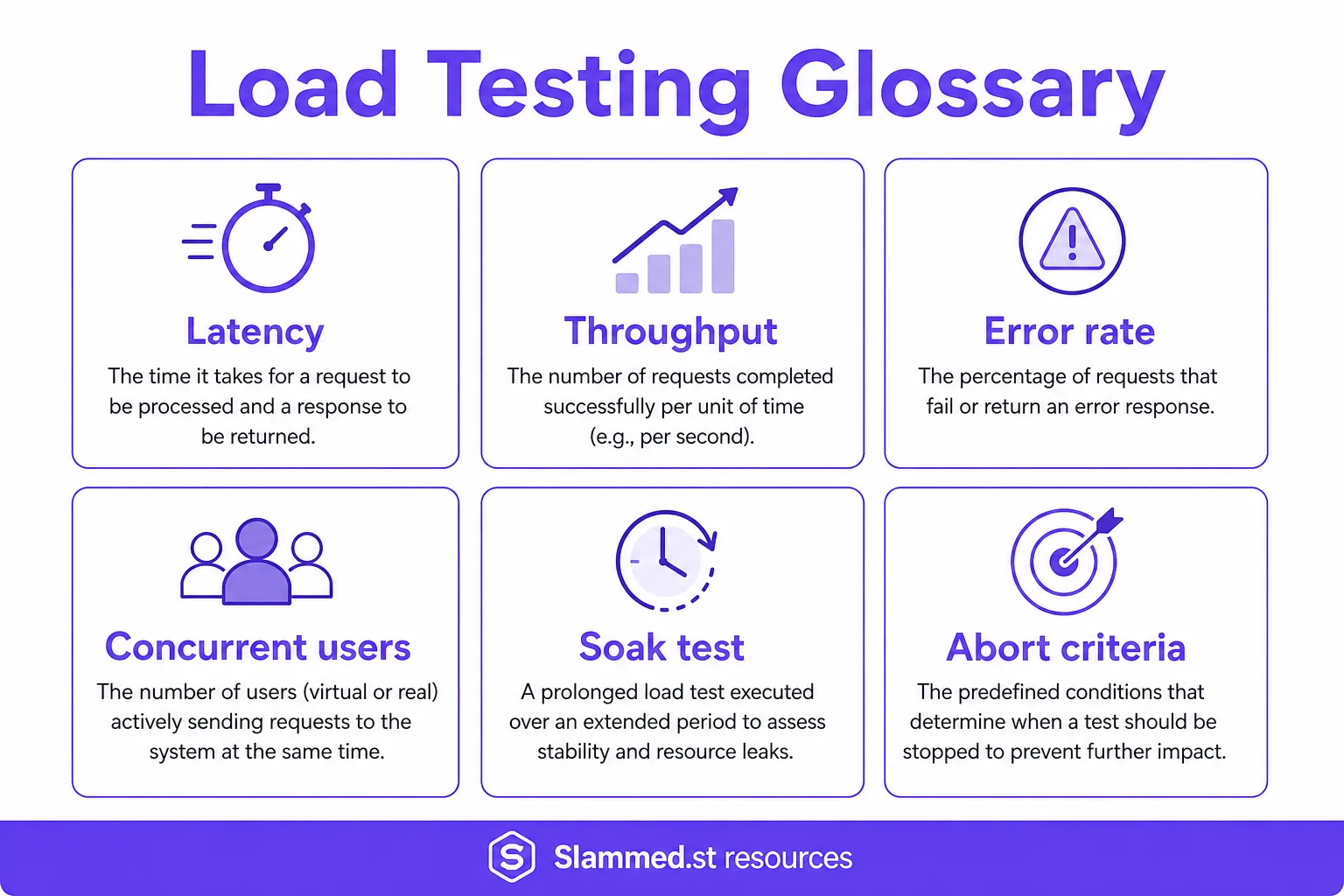
Latency is the elapsed time from starting a request until a useful response returns — the first signal that queues, TLS, or backends are saturating under authorized load.
Definition
Latency measures how long a client waits for a meaningful response. In Layer 7 tests that is typically end-to-end HTTP(S) time; in Layer 4 contexts operators also watch connection setup and network path delays. Averages hide long tails, so capacity work prefers p95 and p99 percentiles alongside mean.
Latency feeds Little’s Law: higher latency means more concurrents are needed for the same RPS. When latency climbs under load, goodput often stalls even if you add workers.
Related: throughput, RPS calculator.
Why it matters for authorized load testing
User-facing SLOs are latency budgets. An authorized stress test that only celebrates peak RPS while p99 explodes is a failed rehearsal. Cliffs often appear first in the tail: a few percent of requests time out while the average still looks “fine.”
Define latency abort thresholds before the ramp — for example stop if p95 exceeds N ms for M seconds — so the run ends when the question is answered instead of hammering a degrading path. Pair with error rate and resource counters on systems you control.
How Slammed.st uses it
Live Hub charts and post-run reports surface latency trends during authorized scenarios so operators can hold, step, or abort. Use those signals next to your APM and CDN dashboards on verified targets only.
Plan a window via free trial or pricing. Vocabulary hub: glossary.
Glossary cluster
Browse related term pages and the hub glossary:
Why percentiles beat averages
Latency is elapsed time until a useful response. Averages hide the tail where users time out. Capacity cliffs often appear in p95/p99 before the mean moves much — treat percentiles as gates in authorized rehearsals, not optional charts.
Pair latency with RPS and error rate. Abort rules often key off latency ceilings — see abort criteria. Glossary home: glossary.
Latency-aware run habits
- Name the route; blended service latency lies.
- Separate edge and origin timings when a CDN is present.
- Include cool-down to see sticky latency after load stops.
- Do not raise concurrents while p99 is already over budget.
Plan sizing: pricing · trial: register · conversion helper: concurrent vs RPS · framing: authorized load testing.
When latency should not dominate the story
Some L4 pipe validations care more about drops and interface errors than HTTP latency. Availability outages can also matter more than a few milliseconds. Still, for user journeys, latency percentiles remain the clearest early warning.
Guides: Layer 7 stress testing · blog · docs.
Related
Resources hub · Glossary · Tools matrix · RPS calculator · Useful network tools · Blog · Pricing · Start free