
RESOURCES
Spike test
A spike test suddenly jumps load to see how autoscaling, caches, and rate limits react — useful for launch and flash-sale hypotheses on verified targets.
Definition
A spike test raises traffic sharply for a short period, then often drops or holds, to observe elasticity and protective controls. It differs from a soak test (long steady load) and from a gradual capacity ramp. Spikes stress cold caches, scale-out lag, connection bursts, and WAF/rate-limit behavior.
Recovery after the spike can be worse than the spike itself — queues, thundering herds, or sticky failures. Always plan cool-down observation.
Related: abort criteria, throughput, RPS.
Why it matters for authorized load testing
Marketing drops, game launches, and ticket onsales create spike-shaped demand. Authorized spike rehearsals on owned systems reveal whether autoscaling and edge rules protect the origin or challenge legitimate users. Tight abort criteria matter because spike intensity can climb faster than humans debate.
Do not confuse a spike with an unbounded attack narrative — the goal is a measured elasticity story inside permission windows.
How Slammed.st uses it
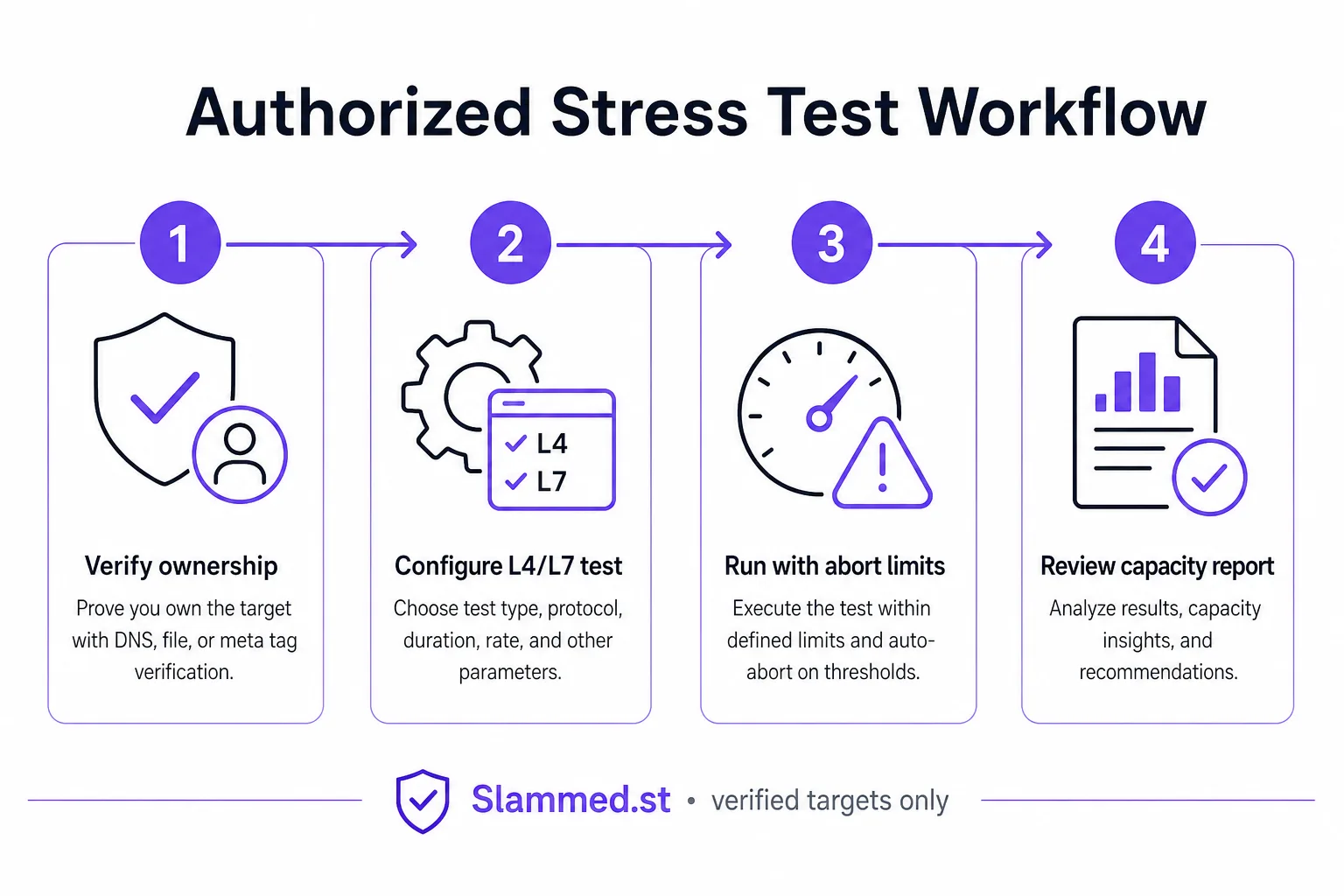
In the Hub, configure a short high-concurrent or high-rate authorized scenario, use multi-region sources when the spike shape is geographic, watch live latency and errors, and stop when abort rules fire. Pair with your cloud autoscaling and CDN dashboards.
Free trial · Pricing · Size concurrents vs RPS · Authorized hub.
Glossary cluster
Browse related term pages and the hub glossary:
- RPS
- Concurrent connections
- Latency
- Soak test
- Abort criteria
- Throughput
- Layer 4
- Layer 7
- Verified target
- Spike test (this page)
- Load testing glossary (hub)
What a spike is — and is not
A spike test suddenly raises load to study autoscaling, caches, rate limits, and recovery. It is not an unbounded attack and not a substitute for a soak. Spikes are useful for launch and flash-sale hypotheses; they are dangerous without tight abort criteria because recovery failures can outlast the spike itself.
Compare with soak test. Index: glossary. Authorized framing: authorized load testing.
Spike run sequence on verified targets
- Write the spike shape (from → to), duration, and abort thresholds with on-call.
- Verify the target; smoke at baseline.
- Execute the jump; watch p95/p99, errors, and scaling events live.
- Hold briefly only if budgets allow; otherwise abort immediately.
- Cool down longer than the spike — sticky queues are the lesson.
Size Hub capacity on pricing. Rehearse controls with a free trial. Calculator context: concurrent vs RPS.
When not to spike
Skip spikes during active incidents, unfinished autoscaler changes, or when authorization only allows gentle soaks. Do not spike third-party systems. If you need leak detection over hours, schedule a soak instead of stacking spikes.
Method guides: Layer 7 / Layer 4. Stories on the blog. Controls in docs.
Related
Resources hub · Glossary · Tools matrix · RPS calculator · Useful network tools · Blog · Pricing · Start free