
RESOURCES
Layer 4
Layer 4 (L4) testing exercises the network and transport path — connections, packets, bandwidth, firewalls, and scrubbing — not your checkout form.
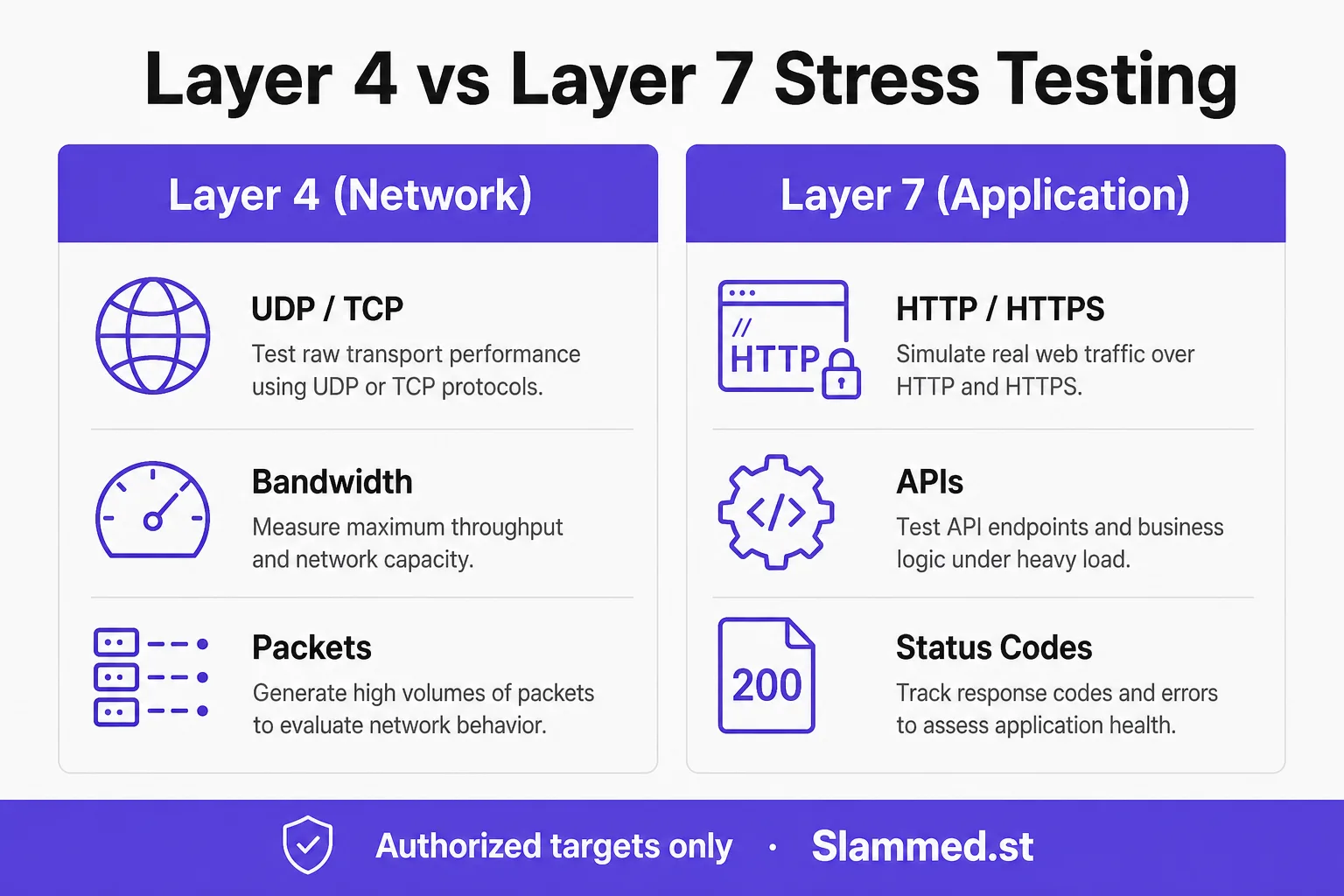
Definition
Layer 4 refers to the transport-oriented view of the stack (commonly TCP/UDP behavior in capacity work). An L4 stress or load scenario pushes connection rates, packet rates, and bandwidth against infrastructure you are authorized to test. Failures often look like drops, resets, or saturated interfaces rather than HTTP status codes.
Choose L4 when the hypothesis is the pipe, perimeter, connection tables, or mitigation onboarding. Contrast with Layer 7, which targets application paths.
Guides: Layer 4 stress testing · L4 vs L7 when to use.
Why it matters for authorized load testing
Many edge and DDoS-onboarding questions are L4 questions. Running only L7 leaves pipe and conntrack cliffs undiscovered; running L4 alone leaves API latency unknown. Authorized programs separate the hypotheses into different windows with clear abort criteria and NOC notice when intensity warrants it.
Never point L4 methods at third-party systems. Verification and AUP exist so capacity tools stay distinct from abuse panels.
How Slammed.st uses it
Slammed.st offers first-class L4 methods in the Hub alongside L7, with multi-region generators, plan limits, verified targets, and instant stop. Peak platform capacity is up to 4.3 Tb/s — your plan and authorization window set the practical run size.
Free trial · Pricing · Tool matrix.
Glossary cluster
Browse related term pages and the hub glossary:
Reading Layer 4 results without false confidence
Layer 4 success means the network and transport path behaved within the budgets you set — not that checkout APIs will survive Black Friday. Teams create false confidence when they publish “held X Gbps” without pairing an application rehearsal. Use L4 for pipe, firewall, balancer, and scrubbing hypotheses on systems you authorize.
Companion entry: Layer 7. Guide: Layer 4 stress testing. Hub framing: authorized load testing.
Metrics and abort habits for L4 vocabulary
- Interface drops and errors alongside Hub-reported volume.
- Connection table / conntrack headroom.
- Mitigation state changes and collateral to legitimate traffic.
- Recovery after cool-down — sticky loss is a finding.
Estimate generator class with concurrent vs RPS / Gbps, then pick a plan on pricing. Trial path: register.
When not to lean on the Layer 4 definition
If product managers are asking about p95 checkout latency, you need L7 language and tests. If CI needs HTTP contract assertions, keep scripts. Never treat L4 glossary text as permission to stress third-party networks.
Related
Resources hub · Glossary · Tools matrix · RPS calculator · Useful network tools · Blog · Pricing · Start free